June 12, 2014

Memories of Cooking at Sea

My friend Jimmy just arrived in town on the tall ship Amistad. They're docked at Portland Yacht Service for some repairs (you can walk down to the boat during the day, but they're not offering public sails or tours), and I had a tour of the boat on Tuesday evening. 

Standing in the huge galley by the still-warm cast iron stove, nibbling on (OK, scarfing down) a slice of some phenomenal cake, I was reminded of my time on tall ships and all the wonderful memories I'd formed, thanks to those boats' galleys. That the best parties end up in the kitchen is a truism on land and at sea. 

Sailing to Catalina Island on Schooner Lynx - Jimmy's the ginger

When I started working on boats, I quickly realized that it paid off to be in with the cook. On my first schooner, I befriended the cook, Jesika, and as a result was always sent off to help her provision at the grocery store. We'd take a taxi or bum a ride from a friend of the boat (there's one in every port) and spend hours filling multiple grocery carts in the store. 

Back at the boat, we'd pass everything down the ladder into the galley, and I'd get to help her organize it. Everything had to be stowed meticulously to save space and so the cook can find what she needs for a meal. All of that work was vastly superior to boat maintenance or chaperoning an educational activity on shore with the kids. 
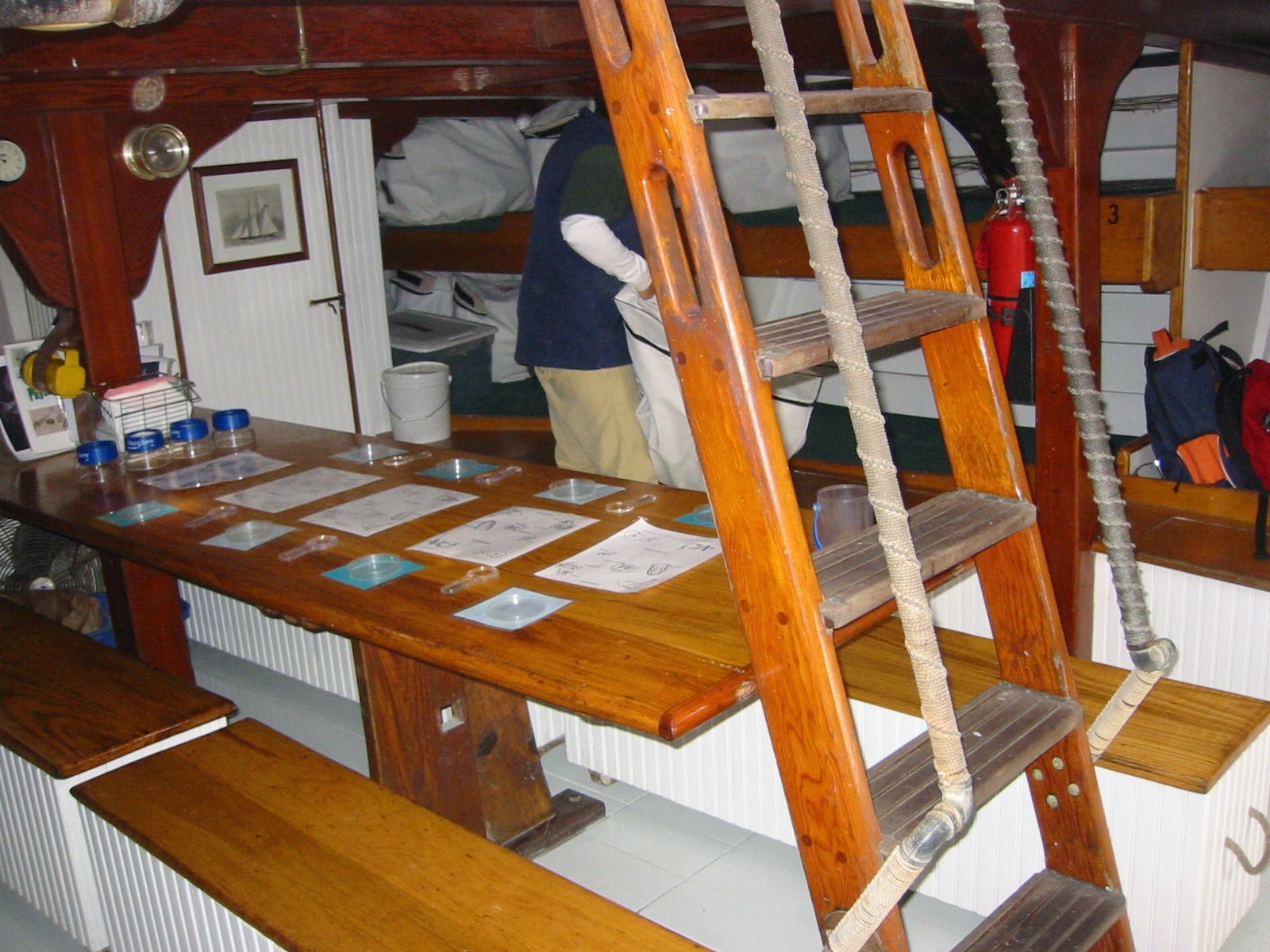
The main cabin of Schooner Lady Maryland - everything that can be sat upon also acts as storage for the galley

Jesika went to culinary school, worked in restaurants, and was an experienced sea cook, so everything she turned out was amazing. Seriously. Leftover night was my favorite, because I could revisit all of my favorite meals from that week all at once. 

She taught me to love yellow Indian curry with potatoes; her barbecue pulled pork was sweet and juicy; I still think of even the simple lunches of homemade naan bread, fried sausage slices, herbed yogurt dip, and a dish of sliced tomatoes and onions. 

Not all cooks make everything from scratch, only the smart ones

Lady Maryland is run by Living Classrooms Foundation in Baltimore and offers educational day trips during the spring and fall and extended live aboard programs for gifted and talented students during the summer. We sailed from Maryland to Massachusetts studying whales. 

At the time, the other two boats in LCF's fleet offered similar day trips during the school year, but couldn't accommodate students sleeping onboard for longer trips. So Mildred Belle and Sigsbee sailed around the Chesapeake Bay to various docks, with the kids and some of the crew camping ashore at night. 

Buy boat Mildred Belle anchored in a river off the Chesapeake Bay

The meal program onboard these boats wasn't as luxurious as Lady Maryland's. There was no paid cook, but rather a crewmember who would peel off from the morning's lessons to lay out lunch for kids and crew. Lunch was usually sandwiches, chips, vegetables, and fruit. 

Dinner was prepared ashore, with all of the kids pitching in on the prep, cooking, and most importantly, the clean-up. Meal planning was done by the crew (usually me, the educational coordinator, and the Captain), and after a summer of hot dogs and hamburgers, we started to get ambitious. 

There was that time I decided to make fried chicken for 20 on a camp stove. After several rounds of frying chicken, I grew tired of the hot splattering grease, and passed the tongs onto an intern. He took over the flipping and frying, and I prepared a plate and dug in. After the intern turned out a few rounds of chicken, a kid came over to me, holding a drumstick with a concerned look on his face. "Is this cooked all the way through?" he asked, holding out the chicken leg. His bite through the chicken flesh revealed a glistening, pink, raw interior. Oh dear. Back to frying duty for me. 

Kate Kana (L) and kids doing dishes on deck of Lady Maryland in New York Harbor

Cooking at the dock on a boat is much like cooking while camping. Cooking underway, however, is a completely different game. I've only ever been asked to fill in for cooks (given very specific instructions) while at the dock. The only food prep I've ever done while underway is getting a sandwich out of the refrigerator. 

Here's the galley of Lady Maryland when Jesika was the cook. Everything has its place and she knows where it all is. Rummaging through the galley when you're hungry is not an option. You can see the shelves have fiddles or lips at the openings, so nothing slides out. Pieces of seine twine are tied across the shelves so nothing tips over while you're underway (the picture below does not show the galley stowed for sea). 


The reefer or refrigerator is either a glorified ice box or actually acts like a real refrigerator with an air-cooled condensing plate. Reefers can get really ugly really fast, so a good cook keeps everything meticulously labeled, dated, and in very secure containers. She'll know just where everything is, so again, no random rummaging. In fact, I don't think Jesika allowed anyone but her, and sometimes me, to get anything out of the reefer. 

Boat stoves are usually propane and are gimbaled, so they stay level while you're at sea. The stovetop has a railing around it, so your pots stay put, and burners have fiddles, or adjustable arms that hold your pots in place. Nothing like catching a hot pot of soup while you're underway. 

Lady Maryland's gimbaled stove - locking mechanism seen lower left corner of the oven

Boat ovens can be notoriously uneven with their heat and need frequent tweaking. Above, I'm helping to fix a temperature sensor on the stove with our captain. God only knows why I was involved in that - short of being one of two people who was allowed to touch anything in Jesika's galley, I certainly didn't know anything about repairing thermocouples. 


Coffee is a boat cook's most important duty - there should always be some prepared, doesn't matter the quality. Above, you can see the some silly setup in Baltimore: Mr. Coffee plugged directly into shore power. Charge the batteries? Pump out the bilge? Sure, that'd be nice. But is there hot coffee? 

On the schooner Lynx, our transits were much longer and, well, shittier, than anything I experienced onboard Lady Maryland. Our cook was an experienced, cantankerous man named Krunch. Krunch is a legendary West Coast sea cook; he sailed for many, many years on tall ships. He also apparently spent several years in a Thai jail for attempting to smuggle hashish out of the country. He told great stories, natch. 


The setup of Lynx's galley is a little strange - it's sort of half above deck, with a passageway down into the main salon where meals were served. There's also a window into the focsle, the cabin forward of the galley, which as a result of the level of the cabins, was at the very top of the focsle, about 8 feet up from the bunk below. 

This window from the galley into the focsle allowed us sleeping below to hear a constant stream of swearing from Krunch, starting at approximately 5am. It also allowed him to issue us an easy wake up call, some variation of "grub's ready, ya shit for brains." (He meant it in the most endearing way, of course.) 

It also illustrated the importance of tying everything down while sailing, even if you don't think it's possible for that object to move/fall over. One Mr. Coffee took a trip down to the focsle, through the galley window, during a long tack en route from Long Beach to San Diego. Fortunately, the bunk below the window was unoccupied on this trip, so no one had to sleep in coffee grounds that night. 

Caught making a bagel late night 

Despite his gruff attitude, Krunch was a great cook. His food was always hot and there was always plenty of it. All his meals were served with his chili scallion oil - a whole mess of dried red chiles and scallions fried in vegetable oil until crispy, then poured into a bottle and topped with more oil.

Now that I know more about food safety, I cringe at this condiment being stored at room temperature. But the crew of 9 men and I always moved through it so fast, it didn't have time to spoil. 


On long or rough transits, food is one of the only things that keeps you going (literally and emotionally). A cup of coffee or hot tea brought to you at the helm by the oncoming watch feels like a godsend. These little things make a difference when you're wet to your core. 

Serving meals in these conditions is no easy task. People are eating, sleeping, and working at odd hours, so there's no one time where all of the crew can eat together. Usually the cook will give instructions as to what's available to eat, and you'll eat after your watch, before retiring to your bunk. 

Meals usually consist of something simple, like a one-pot meal that can be kept warm on the stove. If you're not feeling well, there's always cereal, English muffins, and peanut butter and jelly. Below, you can see the black non-stick laid out on the table, which at least gives your bowl a fighting chance at staying on the table. 

I'll just have toast, thanks. 

Now we have a boat to sail in Portland's Casco Bay, where eating and cooking on board is much easier. It's more of novelty than a necessity. Detour is stocked with a galley fit for cruising: an ice box reefer, a small one-bay sink (now with running water!), a two-burner propane stove, a one-burner, gimbaled propane burner that holds a tea kettle (pretty nifty), and a grill off the back rail. 

Cruising in Casco Bay

We've grilled pizzas, fried bacon, and even scrambled eggs on the grill; it's pretty sweet. Mostly though, we just pick up a few Italian subs, fill the cooler with beer and ice, and we're off. Lunch can be had after the anchor's dropped, and we swim ashore to some island's sandy beach. Pretty luxe compared to the coffee-pot-in-your-bunk lifestyle.

Sailing on tall ships taught me how important systems are on a boat. Big boats are like an organism. In order to keep everyone healthy (again, literally and emotionally), everything has to have a place and everyone needs to do their part to make sure things are in their place - whether you're talking about the boat itself, a pencil at the navigation table, or the Sriracha for a meal (never misplace the Sriracha).

Now that I'm a recreational sailor, I'm free to implement whatever systems on board my boat that I see fit. I still clean the boat and the dishes the same way I learned on tall ships. But the difference is late night snacks are encouraged, everyone's allowed in the galley, and if we're not having fun anymore, we'll just head for shore.

Note: for tips and recipes for cooking at sea, see cruisers Barb and Stewart's blog Harts at Sea, where Barb is chronicling their adventures. She has a great section for Galley Tips and Recipes.

June 6, 2014

Portland Food Signings, Flea Bites, and Timber Steakhouse Peek

Thank you to everyone who attended the launch of Portland Food: the Culinary Capital of Maine at Sherman's Books last Saturday! We certainly packed out that bookstore. Special thanks to East End Cupcakes and Dean's Sweets for donating treats for the singing, and to Josh Christie for securing local goodies from Standard Baking Co., Rosemont Market, and Pineland Farms. 

Munjoy Hill News writer Carol McCracken featured a nice write-up of the afternoon and my book. Friend Sharon Kitchens also blogged about Portland Food, for Huffington Post Taste. 

I'm having another singing at Books-a-Million in South Portland, next Saturday, June 14th from 2-4pm. Come and pick up a signed copy of Portland Food for your dad!

Photo by Carol McCracken
This weekend is predicted to be full of beautiful weather with plenty of food and drink events. Tonight is the first Flea Bites of the season - a food truck clustering down at Portland's Flea-for-All from 6:30-9:30pm. Participating food trucks are Bite Into Maine (event organizers), Mainely Burgers, Mainely Treats, Wicked Good, Urban Sugar Mobile Cafe, Fishin' Ships, and El Corazon.

I have, for some unknown reason, really fixated on Fishin' Ships. They seem really nice, they use local, sustainable fish species, and they rock a lot of nautical puns. It's like their marketing is tailored to me. So they'll be there, with a menu of fish fried coated in different flavored batters, served with creative dipping sauces.

From Fishin' Ships facebook
BUT, I am also really looking forward to trying Mainely Burgers. This truck is run by two current college students, so we had to wait for their semester to finish before it could launch. I hear the burgers are some of the best in town. 

And then there's my old favorite, Bite Into Maine. I just didn't get lobster rolls until I had one of theirs. They're full of the perfect amount of meat (you find yourself eating extra lobster meat, rather than empty hot dog bun), and the buns are so nice and buttery. Wish me luck trying to either eat all of that for dinner or narrowing it down to one. 


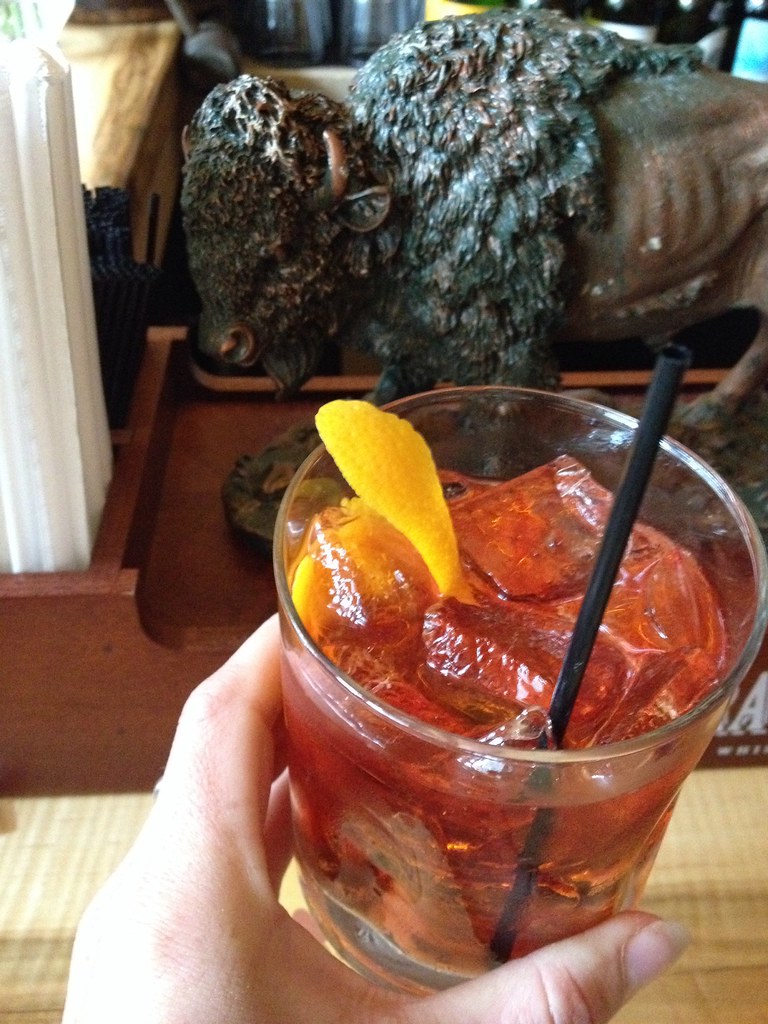
I checked out Timber Steakhouse for happy hour yesterday and ordered this Campari and bourbon cocktail (it has a name - something on their speciality cocktail list) at the suggestion of friendly bartender Henry, formerly of El Rayo Cantina. I asked about the Negroni and said, oh but it comes up... (I didn't want an 'up' drink), and he said, no, it doesn't! It comes however you want it! Love it. 

Timber is from the guys who own the North Point, and their friendliness and dedication to the customer's experience continues to show. The restaurant has been completely redone (unrecognizable as the Oriental Table) and features a bona fide steakhouse menu - creamed spinach, wedge salad, and large-and-in-charge meats. I just ate a side of potatoes gratin by myself - great happy hour snack, huh? It was that kind of day. It was fabulous, and I'm looking forward to trying Timber's wagyu burger ($16). 

Whether you end up at a posh happy hour or eating fish and chips from some newspaper, I hope you have a great, beautiful summer weather weekend! 

June 4, 2014

Where coffee reigns supreme

Originally published in the Portland Phoenix on May 21, 2014

Coffee By Design's new spot in East Bayside 
Portland makes it onto many lists for its food and drink scene; some of the accolades are noteworthy (like Bon Appétit’s “foodiest small town” in 2009), while others are forgettable (namely the ones comparing our Portland to the other Portland). But the results of a Men’s Health study recently made us take notice: Portland is the number one coffee-loving city in the United States. To create these rankings, the study surveyed households in 100 major metropolitan areas, considering the number that own coffeemakers and buy coffee; the amount spent on coffee; the number of coffee shops per capita; and the number of individuals that drink five or more cups a day. Though that last number may be less important than you’d think — according to Maine author Murray Carpenter in his recent book Caffeinated, as a country, we’re drinking less coffee today than our grandparents were.

Rather, the recent proliferation of coffee houses and roasters in Portland points to a growing appreciation for a quality cup of coffee rather than a high quantity of it. Recently, the coffee industry has entered what is described as its “third wave;” the first wave being the introduction of widespread consumption of coffee in our country in the 1950s and ’60s. First wave coffee companies sought to maximize profits, in part by creating demand for their product as part of a daily ritual. Second wave coffee is the movement most of us are familiar with and saw the rise of differing roast levels, publicized countries of origin, and espresso drinks.

Coffee houses embracing a third wave philosophy now pay close attention to every step of coffee production, from growing to harvesting to roasting to brewing. Vien Dobui, Tandem Coffee’s wholesale accounts manager, explains that producers have only started growing coffee with an eye towards quality in the last 10 years. Much like wine, coffee grown in different parts of the world expresses different characteristics based on the climate and soil. Coffee roasters are now paying more attention to these flavor subtleties and roasting beans accordingly.

The way coffee professionals evaluate the quality of coffee beans is a standardized smelling and tasting ritual called ‘cupping.’ Cuppings help coffee wholesalers determine if beans are worth buying and coffee roasters determine to what degree to roast coffee beans, among other things. The cupping process aims to control as many variables as possible, so one tastes only the flavors inherent in the coffee beans, rather than those imparted by the roasting process. Tandem Coffee offers cuppings to the public to help coffee aficionados (or wannabes) learn more about coffee flavors.

I attended a cupping at Tandem Coffee in an attempt to expand my limited knowledge of my own coffee preferences. While I always brew coffee at home and enjoy several cups throughout the morning, I don’t pay much attention to the pedigree. Beyond rejecting a very dark roast, I had no inkling whether I’d prefer a Kenyan coffee to a Columbian. The day I attended Tandem’s cupping, Vien Dobui prepared four samples for us to try. Two were roasted by Tandem’s owner Will Pratt: a Costa Rican and an Ethiopian coffee. Another Ethiopian varietal was sent to Tandem as a sample, and the fourth was a natural Ethiopian coffee from Seattle-based Slate Coffee Roasters.

The cupping was attended by a small group of regulars, both young and old. I was graciously welcomed into the group and shown the routine. First, we sniffed the dry coffee grounds. Dobui then meticulously poured hot water over the grounds, allowing them to steep. We rotated around the table, bending to sniff the brewing coffee. After it was steeped, we selected silver-plated spoons to “break the crust,” or swipe our spoons through the floating coffee grounds to release the aromas trapped beneath. After the second round of smelling, Dobui removed the floating grounds and the tasting began.

We were encouraged to violently slurp up our coffee (Dobui demonstrated with the most vehement of sips) to aspirate the coffee over all of our taste buds. Because I was concerned with choking on hot coffee in front of strangers, I stuck with a more modest slurp. For about 20 minutes, we circled the table, taking repeated sips of coffee. Different flavors become more pronounced as the coffee cools, so an extended tasting allows you to experience a range of aroma and taste.

While sipping the four samples, my thoughts went like this: “Hmm, tastes like coffee... also tastes like coffee... yup, coffee again... Woah!” The fourth coffee tasted radically different due to the processing method. The Ethiopian coffee from Slate was naturally processed, meaning the fruits of the coffee plant, called “cherries” (inside of which you’ll find the “bean” or seed), are dried in the sun rather than mechanically pulped and then dried. The resulting coffee frequently is full of berry flavors; this one tasted like someone had infused it with blueberry syrup.

After our tasting had concluded, we then shared our thoughts on the various flavors we detected. Tasting descriptors are notoriously wacky, but the ones I heard were relatively tame. Many found the Costa Rican roasted by Tandem to contain caramel flavors; Dobui explained caramelized sugar flavors are created by a darker roast. Other descriptors pertained to the acidity of the coffee (typically fruit flavors), the body (any flavor other than fruit), and the mouth-feel.

Determined to continue my coffee flavor education, I headed to the Speckled Ax on Congress Street and ordered two different kinds of coffee to taste side-by-side. When I explained my project to the barista, she exclaimed, “Oooh, you’re one of us!” which made me laugh. She selected a Kenyan and a Columbian coffee, described as tasting of, among other things, “cola” and “pineapple,” respectively. I detected neither, but did taste a noticeable difference between the two. The Kenyan coffee had a tomato-like acidity, while the Colombian expressed a pleasing sweetness as it cooled. The baristas continued to check in with me at my perch at the bar to discuss the coffees’ characteristics.

Coffee By Design’s new space on Diamond Street in East Bayside offers plenty of room to sit and contemplate the flavors in your mug. The staff plans to offer regularly scheduled public cuppings this summer; in the meantime, their attentive staff is happy to recommend a coffee for your palate. The barista recommended a sweeter, nuttier-tasting Peruvian coffee, because I drink my coffee with cream. I tried it straight up first and appreciated the lighter roast, what CBD calls their “peak” roast. This light roasting style allows the flavors of the coffee to shine, rather than being dominated by a darker French or Italian roast. This new location is a mecca for coffee geeks, with multiple high-tech brewing methods and a station for creating your own blend of coffee beans for home use.

At Bard Coffee, store manager Brittany Feltovic prepared me two Kenyan coffees: one naturally processed and one washed. The natural coffee tasted very different than the one I’d experienced at Tandem Coffee, but I couldn’t quite articulate how. Feltovic coached me, saying she tasted “juicy lime,” rather than the more common berry flavors, but no matter how hard I thought of a key lime pie or a margarita, I didn’t quite get there.

Unlike wine, coffee’s flavor differences are subtle. When drank side-by-side, coffees certainly taste different, but identifying those fruity, buttery, and smoky flavors requires an experienced palate. The cuppings at Tandem Coffee provide the perfect environment for training your taste buds, while Portland’s many coffee houses offer ever-expanding options for finding your favorite flavors. Look for a second location from Tandem Coffee this summer at 742 Congress Street in the West End.

Tandem Coffee Roasters cuppings | 122 Anderson St, Portland | Fridays at 12 pm | 207.899.0235

May 28, 2014

"Portland Food" Launch Party Week

Tonight! Get thee to The Thirsty Pig on Exchange St. in Portland for a limited release from Bissell Brothers Brewing. Swish, a hopped ale, will be available tonight as a thank you to the pub where the Bissell Brothers got their start. Get there at 7pm to get a taste of what's sure to be a delicious brew. Even if you are late to the party and miss the Swish, the Thirsty Pig has a great lineup of local beer to console yourself, including (as of yesterday anyways) Maine Beer Company's Dinner. 


The launch party for my book, Portland Food: the Culinary Capital of Maine, is this Saturday, May 31st! It will be at Sherman's Books, 49 Exchange Street, in Portland, where another History Press author, Josh Christie, works. I will be there from 1-3pm, signing books and offering some local treats that are featured in the book. Please stop by! 

Photo via Sherman's Books

Anestes of Portland Food Map is teaming up with the Maine Brew Bus to offer a tour about a different kind of brewed beverage - coffee. The specialty "Portland Loves Coffee" tour is this Sunday, June 1 from 1-5pm. You'll tour several different Portland coffee houses and learn about the roasting and brewing of Portlander's second favorite drink. Anestes knows and loves his coffee, so it will be an entertaining and educational tour. 


May 20, 2014

New Ball Canning Products Review

This summer, UMaine Extension is partnering with the Portland Farmers' Market to offer canning and freezing demonstrations monthly at the Saturday market in Deering Oaks Park. We're participating in the "Discover You Can" partnership sponsored by Ball, in order to help increase people's use of local foods year round. At each demo, we'll have tons of preserving supplies and coupons to give away. The boxes (and boxes) of food preservation goodies are rolling into our office.

Lately, Ball has been creating all sorts of accessories for preserving and using local foods. New toys are fun and all, but I was a bit skeptical about some of these items. So I decided to test drive them all to better inform my recommendations to interested preservers.


First up, accessories for turning your mason jar into a drinking glass (er, rather a more effective one?). I think Ball must have realized they'd been scooped for a great product idea by Cuppow. Ball caught on and produced these sippy lids with accompanying plastic straws. They come in both regular and wide mouth sizes, 4 to a pack, for $6.95. I really enjoy the Cuppow lids and find the Ball version to be comparable. They're great for my iced coffee and don't leak. The straw is long enough to use with pint and half or quart jars.
Verdict: take


The mason jar infuser is a similar idea, only there's a separate screw-in insert that can be filled with ingredients with which to flavor your water. I was skeptical, but when I filled mine with raspberries, I ended up drinking my water much quicker. Combine this with my SodaStream water and I'd be in heaven. So maybe just add some raspberries to my water next time? For $7.95, I think I'll stick with the low-tech version.
Verdict: toss


I definitely had my eye on these little herb jars when they were released last year. They're priced reasonably at $6.95 for a set of four, including the jars. The top pops open to shake out herbs and easily screws off for measuring more amounts. As someone who buys herbs and spices in bulk, I appreciate these jars as a huge improvement over the plastic zip-top bags that clutter up my spice shelf. 

They're also great for storing your home grown and dried herbs (see my dried oregano pictured above). The lids are also sold separately for $2.95 for two, perfect for someone who already has plenty of 4 oz. jars. 
Verdict: take


This alien-like contraption is Ball's fresh herb keeper. The white cradle swings open to allow easy access to the fresh herbs. When it's closed, the stems of the herbs sit in an inch of water, helping to extend their lifespan. 

This product might be helpful to someone who is always losing herbs in their crisper drawer, only to rediscover them as a black pile of goo, since the clear container reminds you what herbs you have. But at $15.95, I'll stick with the wrap-in-a-paper-towel method. As a coworker said, you could buy so many herbs with $15.95!
Verdict: toss


The idea behind this potholder helped win me over instantly. The hot jar handler ($10.95) allows you to hold onto hot jars while you're filling them. This would be useful while you're ladling food into the jar or while you're screwing on the screw bands. It grips nicely around a pint jar, but a smaller jar would get lost in it. The price is a bit steep for a pot holder, so I'll recommend it with reservations.
Verdict: take(ish)


I can tell you right away that I was predisposed to dislike this Sure Tight band tool ($9.99). I think I've been disparaging it while teaching classes without have ever even tried it. This tool's purpose it to help you perfectly tension your screw bands (the metal ring that holds the lid onto the jar during the canning process). To use it, you open up the tool, place the inner rubber-lined plastic ring on your canning jar, close the tool and twist. The spring-loaded hinge in the handle provides the torque to properly tighten your screw band. There's also a jar opener in the end of the handle.


But I was taught, and have been subsequently teaching, that you tighten your screw bands until they're fingertip tight. They need to be on the jars firmly, but not so tight that the air can't escape from the jars during the canning process. Recommending someone use a tool to tighten their screw bands seems counter-intuitive to me. 
Verdict: toss

OK, reading reviews online shows that this tool is useful to people who have arthritis in their hands and wrists. If that's you, give it a whirl! 


The home canning discovery kit ($11.99) is a sort of all-in-one kit for people curious about canning. It contains three pint jars and a green plastic basket that takes the place of a canning rack and a jar lifter. The basket fits into a small stockpot that you likely already have. 

This kit would be perfect for someone who is interested in canning, but doesn't want to buy the whole kit and caboodle or someone who is looking to can small batches at a time. If you're an experienced canner, you have no need for this, but it would make a good gift for people you're looking to convert.
Verdict: you decide.


In what seems like a "wait, people are buying things for canning that aren't Ball branded; we can't have that," move, Ball made pickle and salsa spice mixes. These 12oz. containers are $5.99 each and are enough spices to make 13 to 14 quarts of pickles and 8 pints of tomato salsa. 

The salsa ingredients are relatively straight forward: dried green peppers, onions, garlic; salt; spices; sugar; sunflower oil; and jalapeno pepper powder. You only need fresh tomatoes and white vinegar to prepare your recipe. But as someone who is looking to make salsa made from fresh, homegrown ingredients, I'm turned off by the dehydrated, non-local ingredients. 

The dill pickle spice mix goes off the rails a bit, containing salt, sugar, spices, dried garlic, calcium chloride (for crispness - also sold separately as Pickle Crisp), dextrose, maltodextrin, natural flavor and color, and silicone dioxide. Compare that to a dill pickles recipe that calls for salt, sugar, dill seed, pickling spice mix, and mustard seed. If you're coming to canning to know what's in your food, adding maltodextrin, a food additive frequently used in soda and candy, isn't in line with those goals. 
Verdict: toss


Let's end on a fun note! Ball released blue heritage jars last year, for the 100th anniversary of the Ball jar. This year, they released green jars, as well as blue and green lids and screw bands. All of the items are safe for canning, but might make your food look a little strange with its blue or greenish tint.

The jars are sold in 6 packs for the same price as a 12-pack ($12.99), so maybe they're better as an occasional accent than as the majority of your canning jars. I personally don't plan to use any for canning, but they'd make fun drinking glasses. I will definitely be using the blue and green lids and screw bands.
Verdict: lids, bands: take; jars: you decide

The best part is, we'll be giving away all of these items at our demonstrations this summer! So if you see something you like but wouldn't necessarily spend money on, come see the Master Food Preservers at the Portland Farmers' Market this summer. The dates of the demonstrations will be announced on UMaine Extension in Cumberland County's Facebook page.

May 14, 2014

Weekly Portland Food Events of Interest

This week, I thought I'd share with you some events of interest - not of course, as an attempt to replicate the comprehensive Events Calendar on Portland Food Map. But every little bit of publicity helps for these businesses putting on great events featuring local food and drink.

Allagash Brewing Company and Rosemont Market Productions are hosting a fundraiser for Preble Street Resource Center tonight at the brewery. Tickets are $45 and include eight samples from Eventide Oyster Co., Rosemont, PB&ME, Nosh, The Thirsty Pig, Browne Trading Company, Gelato Fiasco, and Winter Hill Farm. Beer sample are offered with each plate. Read about the last Allagash dinner I attended to preview all the fun you're in for.


The Portland Phoenix Best Of party is also tonight; the winners for Best Food Blog will be announced (for which I am a contender) as well as all their other award winners. The event is free and starts at 6:30PM at Port City Music Hall. Food (also free) is provided by Black Tie Company, the bar will be open, and local music acts will be playing. 

An ongoing event is a Kickstarter campaign for the Bearded Lady's (Nan'l Meikeljohn) Jewel Box. Nan'l is a bartender, most recently seen at Pocket Brunch events and pop-up bar events at SPACE Gallery. He's launching his own bar, the Jewel Box, at 644 Congress Street and is looking to raise funds for the remodel. The video is an entertaining watch, and note that if you pledge $75 or more your reward is a ticket to a future (one last) Pocket Brunch in the fall at the bar. 


I'm not much for events on the weekend, but the Portland Museum of Art is hosting a film screening on Sunday. What with the weather report, it might be a nice thing to cozy into. As part of the MOFGA lecture series, the PMA is showing Symphony of the Soil at 2PM. There will be a discussion panel following, featuring filmmaker Deborah Koons Garcia, organic farmer Eliot Coleman, and Aurora Provision's Leslie Oster. 

Of course, the rainy weather is also a great excuse to stay inside and read! My book, Portland Food: the Culinary Capital of Maine is now available for purchase in local bookstores, Books-a-Million, and online

May 9, 2014

Food truck fleet updates

Portland food trucks are coming out of hibernation, so we thought we’d check in with the existing fleet for an update on their upcoming season. First, the good news: most truck owners were very happy with their first year of service in Portland. Only one truck ran out of gas, so to speak, after a season in Back Cove Park — Portside Picnic. Owner Rich Earle cites costly permits as well as size and location restrictions as his reasons for closure.

In fact, only a handful of trucks manage to operate successfully on city property. Gusto’s Italian’s business is booming, serving filled flatbread cones and fried snacks to late night revelers in the Old Port. But owner Jim Chamoff says parking is difficult to find late at night (city regulations allow for the operation of food trucks in any non-residential area after 10 pm). As a result, Gusto’s employees head out to find parking at 5 or 6 pm and then have to run generators for several additional hours to power the truck’s refrigerators.

The owners of El Corazon established themselves on Spring Street at Temple Street, serving Mexican fare to the business crowd on weekdays. Food trucks are allowed to operate on designated streets as long as they feed the meters. El Corazon owner April Garcia says it’s particularly important to maintain a consistent presence in one location: “We established this spot as this is where we are; people know we’re going to be there.”

Kevin Sandes of Urban Sugar Mobile Café (the mini-donut truck) only experienced a few months of service in Portland last fall before heading to Sugarloaf for the winter. He tried his luck on Commercial Street by the cruise ship dock, hoping to capture tourists’ business as they came off the boat. But he found the limited space allowed for food truck parking was taken up by the cruise ship vans taking passengers on daytrips. Kevin and his wife Valeri will be back this season, operating on city property during the week and in Portland Flea-for-All’s parking lot on Sundays.

Most trucks choose to rent space from a private business on the peninsula or motor out of Portland altogether. The Small Axe food truck’s chefs sold their carefully-crafted breakfast fare to Tandem Coffee’s customers in East Bayside and leased space in a parking lot next to City Hall for lunch service. This year, owners Bill Leavy and Karl Deuben easily renewed their food truck’s operational permit with the city and plan to serve lunch and dinner from the privately-owned lot. Deuben said, “Our process with [City Hall] was really smooth, in that they sent us a renewal form and we sent them money, and we want to keep it like that.”

Nate Underwood’s Wicked Good truck headed out to Peaks Island, where he served “wicked” items like chicken and waffles. With a second truck in Portland this year, Underwood hopes to emphasize the revamped “good” side of the menu, with vegan items from Modern Vegan’s Chris McClay.

Last August, the city changed its regulations to allow food trucks to cluster, like at the popular monthly Flea Bites event in the Portland Flea-for-All parking lot in Bayside. Flea Bites returns in May, and Jack Barber of Mainely Burgers plans to participate. Barber is looking forward to “creat[ing] a destination where everyone in the family can find something they like.”

Four new trucks are launching this year: Ana’s Mobile Gourmet was recently spotted serving Mexican food and plans to launch full-time mid-May. Good Shepherd’s food truck has just started serving at special events, with all proceeds going to the Food Bank. Fishin’ Ships, with a variety of fish ‘n chips, plans to launch this summer; and Anywhere Coffee Bar from Gorham Grind is aiming to be in operation June 1.

Scope out this year’s mobile fleet at the upcoming Street Eats & Beats event, featuring Gusto’s Italian, Wicked Good, El Corazon, Small Axe, PB&ME, Love Cupcakes, Good Shepherd, Pinky D’s (Lisbon Falls), and Sweet Tomatoes (Boston).

STREET EATS & BEATS | Saturday, May 3, 12-5 pm | Ocean Gateway Lot | $10 | tinyurl.com/streeteatsandbeats

Originally published in the Portland Phoenix, April 25, 2014

April 11, 2014

A taste of Mexico in Maine

Originally published in the Portland Phoenix on March 28, 2014

El Rayo Taqueria in Portland prides itself on serving authentic Mexican fare using fresh and local ingredients. But until recently, the workhorse of many El Rayo dishes — the tortilla — was bought from an out-of-state purveyor. Enter Lynne Rowe with her new tortilla business, Tortilleria Pachanga.

El Rayo’s kitchen manager Elena McMahan reports Rowe’s yellow corn tortillas, which she just started serving in the past week, are a hit with the restaurant’s customers: “[T]he difference is definitely that Lynne makes them from total scratch — the process of soaking the corn with lime overnight, grinding it into masa, and making the tortillas almost daily makes all the difference in the world!”

Rowe had the idea to make her own tortillas from locally-grown corn after traveling to Oaxaca, Mexico. A lifelong Spanish teacher, Rowe was inspired by the open-air markets where women knead fresh cheese and press tortillas made from masa, a corn dough. Rowe had plenty of experience making tortillas from dried masa at home and with school groups. But she struggled to find fresh masa to recreate the authentic flavor she enjoyed in Mexico. So Rowe decided to make her own, ordering a 50-pound bag of organic, Maine-grown yellow dent corn (from Sandy River Farms in Farmington) through the Crown O’ Maine Cooperative. Armed with a hand grinder, she began the laborious process of making fresh masa.

First Rowe soaks the corn kernels in food-grade lime, an ancient process called nixtamalization that breaks down the kernels’ coating and makes its nutrients readily available. The kernels are then soft enough to grind, which Rowe does with a stone grinder. The resulting paste is masa, which is then portioned into balls and pressed into tortillas. The finished product is gluten-free, low-sodium, organic, and high in fiber and vitamins, in particular B3. But above all, it’s tasty.

Rowe’s locally-made tortillas are part of a growing sector of food manufacturing businesses in Maine: entrepreneurs making value-added products. Value-added products are foods that have been processed to increase their value to the consumer, like turning strawberries into jam or grains into flour. The term encompasses specialty foods like gourmet sauces and spice rubs, but also pantry staples, like oils, dried fruit, and nut butters.

University of Maine Cooperative Extension Business and Economics specialist Jim McConnon says that as of 2011, there were 370 self-employed food manufacturers in Maine. This sector has grown by 50 percent in the last 10 years, whereas the number of large food manufacturing businesses has stayed relatively stable in that time.

“I’m excited about opportunities and possibilities for Maine people to follow their passion and create things and at the same time... bring more money in to their families and their communities than they expend,” McConnon says. “As long as they’re business-savvy, they have half a chance, particularly with value-added [products].”

Rowe has expanded her tortilla operation into a production space on Industrial Way in Portland next to established brewers Allagash Brewing and up-and-comers Foundation and Bissell Brothers Brewing Companies. A new machine, purchased with funding from a successful Indiegogo campaign, is capable of pressing and cooking 12,000 tortillas per hour. Rowe has learned to talk about “fixed overhead costs” and “profit margins,” while ensuring she stays true to her mission of using Maine-grown corn to produce fresh tortillas. Rowe hopes her business will help the Maine corn industry — in particular increasing the availability of heirloom varieties like the Abenaki Flint corn grown at Songbird Farm in Sparks. But above all, any tortilla connoisseur will appreciate Rowe’s products for their authentic flavor and texture.

Tortilleria Pachanga tortillas can be found at Rosemont Market, Aurora Provisions, El Rayo, El Corazon food truck, and area farmers’ markets.

TORTILLERIA PACHANGA | facebook.com/tortilleriapachanga | 207.797.9700 | tortilleriapachanga@gmail.com

March 6, 2014

A tequila-tasting education

Originally published in the Portland Phoenix on February 20, 2014

Outside, the city is digging out from under its fourth (or is it fifth?) heavy snowfall. But inside Zapoteca Restaurante y Tequileria, a warming bit of Mexico can be found in the form of an extensive selection of tequila. Sit at the bar in a luxe, dark-leather bar stool, and let the knowledgeable staff pour you a flight of warming libations or a snifter of an aged liquor that’s the color of caramel.

If your only experience with tequila involves the grimace after the lick-slam-squeeze of a salt and lime shooter, you may be surprised to hear that tequila is now being treated stateside with the same reverence as bourbon and scotch. Similarly, tequila has its own Appellation of Origin, a set of standards governing the production of tequila. In order for tequila to be called tequila, it has to be from specific territories of Mexico and produced in compliance with standards that cover everything from the fermentation process to the packaging.

Tequila is made from the blue agave plant, which grows in Mexico, South America, and the Southwest United States. The succulents resemble aloe with their thick, fleshy leaves, and are harvested for their hearts, like an artichoke. These hearts or piñas look like large, starchy pineapples and are split and roasted traditionally in a stone or brick oven, called a horno (hence Sauza’s Hornitos). The roasting process breaks down the agave’s starches into fermentable sugars. The roasted agave hearts are then crushed to release their juices, which is fermented in a process very similar to that of beer. The mildly-alcoholic agave wort is then distilled twice to produce tequila.

If the tequila is unaged, it’s called blanco or silver and is the best way to taste the pure agave flavors. Reposado or ‘rested’ tequila is then aged in oak barrels for two to 12 months. Reposado tequilas are great sipping tequilas for beginners, since the aging frequently mellows the more lively flavors of tequila (think pepper, citrus) and adds complexity. Añejo is aged for one to three years, and extra añejo is aged for a minimum of three years. Añejo tequilas are comparable to Scotch whiskey, infused with smoky flavors from the charred oak barrels in which they’re aged.

To decide which style you like best, head to Zapoteca for a flight of tequila. Zapoteca boasts the largest collection of tequila and mezcals in Maine (close to 80), which are managed by Sergio Ramos, who has completed the “Award T” certification course from the Tequila Regulatory Council of Mexico. A flight of tequila offers the three styles of tequila from one brand, giving you a chance to see how the flavors of the tequila change as it’s aged. The flights range in price from $15 to $80 and come with a palate-cleansing side of sangrita, a spicy slurry of fire-roasted tomatillos traditionally served alongside tequila to complement its acidity.

Recently, I sampled a flight of Tres Generaciones ($18). The silver tasted like you expect fine tequila should — peppery with a clean finish. As I moved onto the reposado, the spiciness mellowed, and I tasted fruity, vanilla notes. The añejo tasted much like the reposado, but with a slight smokiness. I preferred the reposado, and even moved on to the Casamigo reposado served neat ($13), which left a lingering caramel flavor in the finish.

At Zapoteca, you can also sample mezcal, another type of Mexican agave liquor. Mezcal is a catch-all phrase used to describe any liquor made from agave (including tequila). But the best mezcals come from the Mexican state of Oaxaca, and Zapoteca has several for you to try. While you may associate tequila more with patios and summertime, why not take advantage of the slower pace of winter in Maine to embrace a tequila education?

ZAPOTECA RESTAURANTE Y TEQUILERIA | 505 Fore St, Portland | 207.772.8242 or zapotecarestaurant.com

February 13, 2014

Fat and happy at Miyake's place

Originally published in the Portland Phoenix on January 30, 2014

The pigs make a racket, squealing and grunting, anticipating another meal, as we gingerly approach on paths of melting snow and ice. I’m in Freeport, where chef Masa Miyake has turned his Freeport backyard into a full-fledged hog farm; farm manager Emily Phillips built paddocks for the pigs and moved them closer to the house for the winter.

“They’re pretty food-motivated,” laughs Phillips. The pens house four different breeds of pigs, all of them eager to sniff us. They crowd against the fence, pressing their round noses against our legs. Phillips points out different breeds as she scratches the back of a fat, black pig named Raisin.

Miyake’s farm is one of many projects keeping the Portland chef busy. In the past six years, Miyake has opened three restaurants — including his Diner which just opened its doors in the original Miyake space on Spring Street — and turned his 3.5-acre Freeport property into a breeding ground for rare and heritage varieties of pigs. Phillips cares for about 15 pigs at Miyake’s farm, breeding them in the hopes of creating uniquely flavored meat. Twenty more of their feeder pigs are being raised by the staff at Wolfe’s Neck Farm, also in Freeport. Miyake’s farm-raised pork is served in all of his restaurants, with Pai Men Miyake using the most of it in their ramen and dumplings. (The pork buns aren’t made with Miyake farm pork, since the farm doesn’t yet produce enough pork belly to supply the popular menu item.)

Miyake started his pork production by raising two breeds of pigs: Landrace and Guinea. Landrace are the typical pink pigs that are bred to be lean and muscular; Guinea hogs are a smaller, rare breed that is unique to the United States. These pigs were frequently raised by homesteaders attracted to their small stature, high fat content, and their rooting behaviors, which helped till garden beds. Phillips says chefs have grown bored with Landrace pigs and are attracted to the high fat content and flavor of Guinea hogs’ meat.

Phillips is looking forward to the birth of three litters of piglets in March. She successfully bred two Mangalitsa pigs, a curly-haired Hungarian breed that’s frequently referred to as the ‘Kobe beef’ of pork. Raisin, a Guinea hog, bred with a Ossabaw Island boar, so her piglets will be a unique hybrid. Phillips’ goal is to establish a strong breeding stock, which is a long process. In the meantime, she’s busy with the daily care of the animals and managing the restaurant’s office operations.

Restaurant co-owner and manager Will Garfield explains that chef Miyake started raising the pigs to provide his customers with a meaningful story about their food. “You can find pork anywhere,” Garfield says. “I can pick up the phone and get six different types of pork from different purveyors. But we wanted at least to be moving in a direction where we could say, this is Miyake farm pork.”

Miyake and his partners aren’t looking to reinvent the wheel with their farming endeavors. They recognize that they are first and foremost a restaurant group and will never be able to farm on the same scale as full-time farmers.

Phillips and Miyake are instead looking to differentiate themselves in the market with their unique pork and produce. Phillips says, “We live in such an amazing place with so many knowledgeable and efficient local farms that produce really quality stuff. So we’ve been trying to envision how we can dig out our little niche within that.”

Phillips took a year off from growing produce on the farm, but is planning to plant Japanese vegetable varieties this year. With her care in the fields and on the farm, and Miyake’s talent in the kitchen, the food at the Miyake restaurants is in good hands.

Find Miyake farm-raised pork at Pai Men Miyake | 188 State St. | 207.541.9204 | miyakerestaurants.com/pai-men-miyake

January 17, 2014

Supporting Maine's dairy farmers for the love of cheese

Originally published in the Portland Phoenix on January 3, 2014

Maine-made cheese is having a moment. The Maine cheese industry is one of the fastest growing in
the country and produces award-winning varieties. While we don’t make near as much as cheese-loving states like Wisconsin and Vermont, Maine has 73 licensed cheese makers today, up from ten a decade ago. Thanks to like prominence of local cheese at retailers like the Portland Farmers’ Market, K. Horton’s Specialty Foods, Rosemont Market, and Whole Foods, curd-loving customers are familiar with local creameries and cheese styles like never before.

Whether it ends up buttery, crumbly, or tangy, all cheese starts out as milk. Maine Cheese Guild President Eric Rector attributes the success of the cheese industry to its high-quality founding ingredient. “Maine produces some of the best milk in the world, in my opinion,” Rector says. Unfortunately, the story of the Maine dairy industry isn’t as rosy as that of cheese. Today, Maine has just under 300 dairy farms, down from 500 in 2000. According to production reports from the Maine Milk Commission, the state’s number of dairy farms decreases every month. Dairy farmers have a hard time making a profit off of fluid milk and are increasingly retiring or selling their cows in favor of more profitable types of farming. A convoluted pricing system created in 1935 determines dairy farmers’ profits. Large dairy farms sell their milk to processors and are paid at a rate that is determined monthly by the state. At times, these payments are not enough to cover even the cost of production.

Smaller operations can fetch a higher price for their product by processing and bottling it themselves. At Winter Hill Farm in Freeport, farmers Steve Burger and Sarah Wiederkehr host a herd of heritage breed Randall cattle. Burger and Wiederkehr purchased the farm from a couple looking to retire and were attracted to the rare breed of cows. Randall cows used to be found on many small family farms in New England, since they are an all-purpose meat, dairy, and draft animal. Burger and Wiederkehr milk eight to nine cows of their herd of 20 and sell raw milk, yogurt, and cheese. Selling their milk at farmers’ markets helps Winter Hill Farm to get a higher price for their product than if they sold to one of the state’s dairy processors.

Smaller dairy farmers like those at Winter Hill Farm frequently choose to diversify their operation by making cheese from their animals’ milk. Cheese sells for a much higher price per pound than the milk itself does. “Particularly if you’re [a smaller farm], you need another outlet to sell to because with dairy prices and the way they fluctuate, cheese making sales provide stability,” says Whole Foods Market’s specialty cheese buyer Shannon Tallman. But animal products like milk and meat are often the last holdout for many locavores. The cost of these products from smaller producers can simply be cost-prohibitive.

Fortunately, there are a multitude of ways to support the industry that produces the milk used in your favorite cheeses. Buying milk that’s processed in Maine helps our dairy farmers too. The three Maine milk processors (Oakhurst, Hood, and Houlton Dairy) pay into a fund that helps to cover dairy farmers’ production costs when milk prices do not. Look for processing plant number 23 on the packaging to indicate that that milk was processed in Maine (see moomilkco.com/got-maine-milk for more information). Consumer support will help strengthen Maine’s dairy industry whether that milk ends up in your cereal bowl or on your cheese plate.

December 21, 2013

Oysters at home for the holidays

When someone describes oysters as tasting “of the sea,” it always makes me wonder the last time they tasted seawater. When I’ve ingested the ocean, it’s usually accidentally, and then I’m coughing, choking, and spitting — not how I’d like to react after eating an oyster. In fact, oysters can taste buttery, mild, sweet, earthy, or briny, and it’s up to you to figure out what you like. As the holidays approach, take the time to explore the many varieties of oysters available in Maine — and perhaps even establish your own tradition along the way. 

Of course you can go to Portland’s raw-bar hot spots Eventide Oyster Co. and Boone’s Fish House and Oyster Room for your shellfish education. Both boast impressive selections of oyster varieties and knowledgeable staff to help you discover your favorites. But there’s something to be said for shucking oysters at home. For one, they’re about half the price at a seafood market (less than $2 each) than at a restaurant. Then there’s the way serving oysters on the half-shell stands to elevate and enliven a gathering. Sharing these freshly shucked treats with your friends and family can make you feel like part of an exclusive club. Requiring a bit of gastronomical courage, eating oysters will help you find the more adventurous people at any holiday party. In order to avoid standing alone with your shucking knife, go easy on everyone and pick up some crowd-pleasing varieties.

First, think small. In oyster speak, a cocktail oyster is under three inches; avoid the intimidating two-bite oysters. Next, select a few different types. Most of the oysters grown on the Eastern seaboard are the same species, but can taste vastly different depending on where they’re from. Just like wine, oysters have their own terroir or sense of place, where the characteristics of the area’s soil or water are expressed through flavor. Chris Miller at Browne Trading Co. recommends Winter Points from Bath for their rich, briny flavor. Small, sweet Beausoleils from New Brunswick are a great variety for beginners and aficionados alike. For someone who likes a challenge, try Belons, the only wild oyster left in North America. True Belons are grown in Brittany, France, so ones grown here in Maine are known as European Flat oysters. These oysters have a strong metallic flavor that’s frequently compared to sucking on a penny.

To successfully shuck your own oysters, you’ll need an oyster knife ($10), available at the seafood market where you purchase your oysters. Above all, be careful. Shucking oysters is supposed to add to a holiday party, not interrupt it with an emergency-room visit. Wash your oysters well to remove the grit on the shells. Use the tip of the oyster knife to pry open the two shells of the oyster at the hinge using leverage, not brute strength. Watch a few videos online to get the basics, and practice your technique until you’re shucking with ease. Serve oysters with lemon wedges — save the cocktail sauce for the shrimp. I know cocktail sauce is everyone’s favorite, but all it does is mask the delicate flavors of oysters.

With a myriad flavors available, there’s no reason to say you don’t like oysters anymore. This holiday season, take the time to explore the terroir of oysters. They’re a safe conversation topic among new acquaintances or cantankerous family members, and provide a welcome break from the usual holiday appetizers. And who knows, maybe you’ll agree with French poet Leon-Paul Fargue’s assessment that eating oysters is “like kissing the sea on the lips.”

BROWNE TRADING CO. | 262 Commercial St, Portland | Mon-Sat, 10 am-6 pm | 207.775.7560 | brownetrading.com

HARBOR FISH MARKET | 9 Custom House Wharf, Portland | Mon-Sat, 8:30 am-5:30 pm, Sun 9 am-3 pm | 207.775.0251 | harborfish.com

Originally published in the Portland Phoenix on December 7, 2013

December 20, 2013

Obscure Holiday Cocktail Tasting, Vol. 5


The obscure holiday cocktail tasting just keeps getting better and better with great company, great drinks, and loads of cheese. Now in it's fifth year, the cocktail tasting has gone from finding obscure holiday cocktails (the list was pretty short) to holiday drinks (gross) to just obscure ones. 

I borrowed The Drunken Botanist from Sharon of Delicious Musings, and found the Aviation cocktail. It's obscure in that it uses Creme de Violette, a liquor (made from violets, surprise) that was popular in the Victorian age. Now there's only one maker of the liquor, but fortunately it's available locally at RSVP. It tastes like Creme de Cassis to me, and sure enough, a recommended use is to pour some into your Champagne.

Aviation
1 1/2 oz. gin (I used Aviation gin, a gift from friends from Portland West)
1/2 oz. maraschino liqueur (I used boozy cherry juice aka bourbon with cherries)
1/2 oz. creme de violette
1/2 oz. fresh squeeze lemon juice

Combine in a cocktail shaker filled with ice. Shake. Strain into a glass and top with a boozy cherry.

The fabulous Shannon (Cheese Goddess) paired my cocktail with St. Nuage, a triple-creme Brie.

Other hits were Dawn's Honey Badger, Meredith and Michael's Holiday Julep and Professor A.'s Want Knot. (Sorry Adam, yours tasted like cream that had been strained through the ashes of an orange zest campfire to me.)

Honey Badger 
Paired with Coupole, a wrinkly-brain rind aged goat cheese

1.5 oz. Hendrick's Gin
1 oz. Honey Syrup
0.75 oz. Lemon Juice
Top with Fatty Bumpkins dry Hard Cider

Holiday Julep
Paired with Oma, a washed-rind, Tomme-style cheese

2 oz. Bourbon (Woodford Reserve is a julep classic)
1 oz. Thyme simple syrup
1 Lemon slice for drink, peel for candied garnish
3 Bourbon cherries

Want Knot
Paired with Ewephoria, a sheep's milk Gouda

1 oz. Maine Craft Distilling Alchemy Gin
1 1/3 oz. Cochi Americano Blanco
1 oz. White Grapefruit Juice
1 oz. Honey Syrup (1 part Japanese Knotwood Honey from The Honey Exchange, 2 parts water)
1/2 tsp. Beast Feast Maine Ghost Pepper Infused Maple Syrup
4 drops Coastal Root Cocktail Bitters
1 Orange Twist

Any one of these will help to get you through/celebrate the holidays with your family next week. And cheese always makes everything better. Happy Holidays!

Read past years' cocktail tastings year 1, year 2, year 3, and year 4 for more cocktail ideas (with varying degrees of success).